
The Hitchhiker’s Guide to Agentic Payments
The agentic economy: how machines will create, trade, and settle value

Foreword
This piece is a long one - but it’s worth the ride. It brings together insights from some of the most forward-looking builders shaping the future of agentic payments. We’ll explore what problems they’re actually solving, how the implementations may work in practice, and where the real bottlenecks lie. Think of it as a guided tour through the frontier - ten pages of ideas, experiments, and lessons from the people building the rails of the machine economy. Buckle up.
About the author: As the ERC-8004 coordinator and AI advisor at the Ethereum Foundation’s decentralized AI (dAI) team, I’ve spent the past months working directly with the builders, researchers, and protocol teams at the intersection of stablecoins, decentralized infrastructure and AI, giving me a front-row view of how these tech are evolving in real time. This piece reflects not just research, but lived context from the people building the foundations of the agentic economy.
Gratitude to Louis Amira (ATXP), Alex Attalah (OpenRouter), Robert Bench (Radius), Davide Crapis (Ethereum Foundation), Nemil Dalal (Coinbase/x402), Cameron Dennis (Near Foundation), Marco De Rossi (Metamask), Don Gossen (Nevermined), Jamie Hinz (Stripe/Privy), Sreeram Kannan (EigenCloud), Kevin Li (Goldsky), Lincoln Murr (Coinbase/x402), Ben O’Neill (Stripe/Bridge), Erik Reppel (Coinbase/x402), Furqan Rydhan (Thirdweb), and Jay Yu (Pantera Capital) for the reviews and discussions. Names ordered in alphabetical order.
What’s happening
A month ago, Stripe and OpenAI rolled out something that might end up being one of the biggest shifts in online commerce since the App Store. You can now buy things inside ChatGPT. No forms, no redirect, no checkout page. Just: “find me a handmade mug,” and it charges your saved payment method through what Stripe calls the shared payment token.
While this flow feels magical, it’s also profoundly centralized and will possibly be very limiting in the future in unlocking fundamentally new capabilities. The payment token, the settlement rails, and even the user identity are all intermediated by a single vendor stack - OpenAI and Stripe. In that model, agentic commerce becomes convenient, but not composable: the agent can only act within one ecosystem. It’s a glimpse of what’s possible, but also a warning - without open standards and neutral settlement layers, agents are platform-locked.
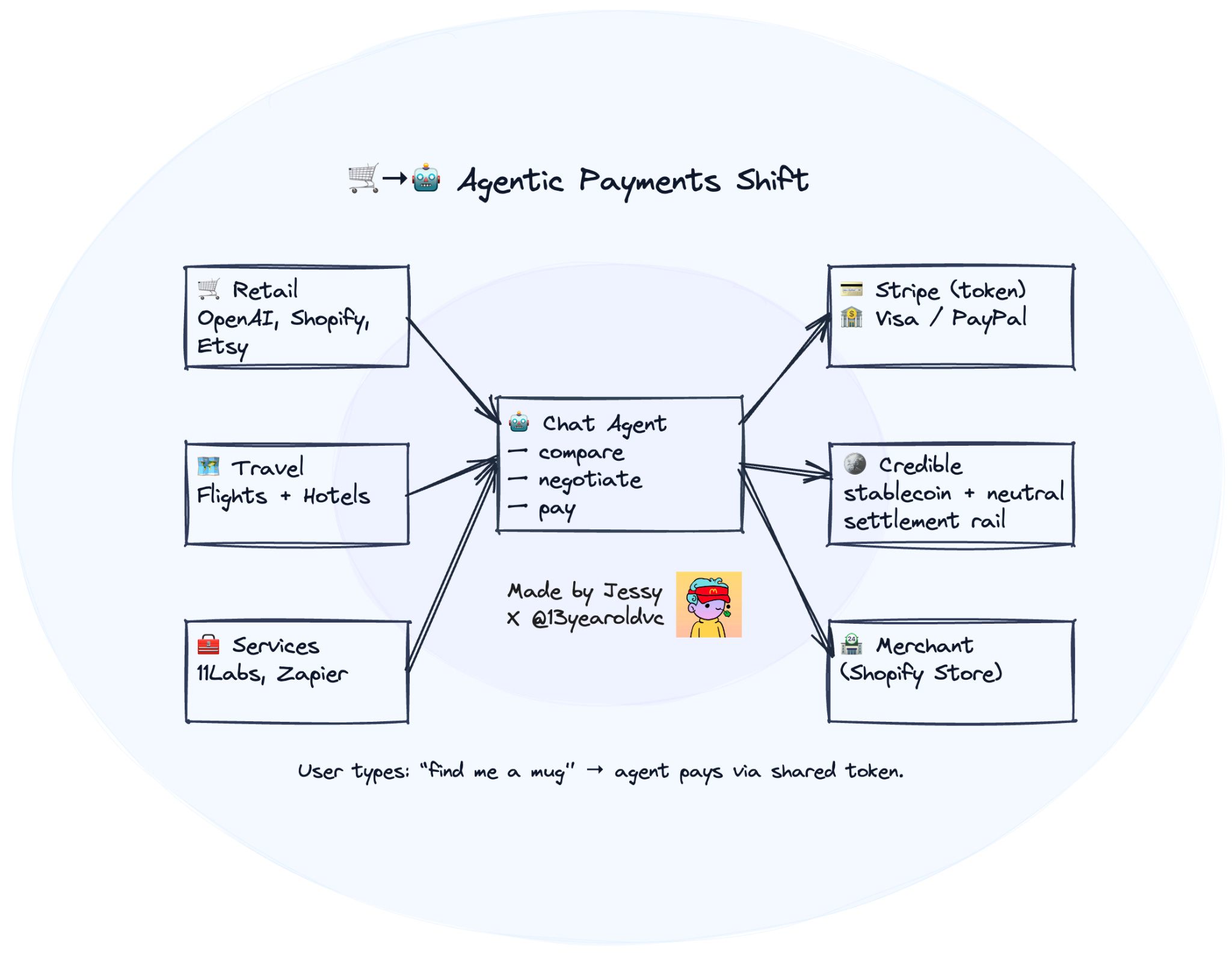
In the meantime, this new flow does mark a bigger shift. The user isn’t really the one transacting anymore - the agent is. The interface we type into is already starting to negotiate, compare, and pay on our behalf. Commerce is slowly getting eaten by agentic commerce.
Three things seem to be happening in parallel:
Agents are starting to transact for humans.
Those transactions will likely settle in crypto rails, not legacy ones.
This might finally be the breakout use case that connects blockchains and AI in a real way.
Why stablecoins & blockchains? Because the shape of these transactions looks nothing like what Visa or PayPal were built for. The agentic economy is full of small, conditional, composable, high-frequency payments - too fast, too granular, too global.
Inspired by a conversation with Robert Bench of Radius, we find 3V3Cs to be a great description model: high velocity, high volume, low value, conditional, composable, and cosmopolitan.
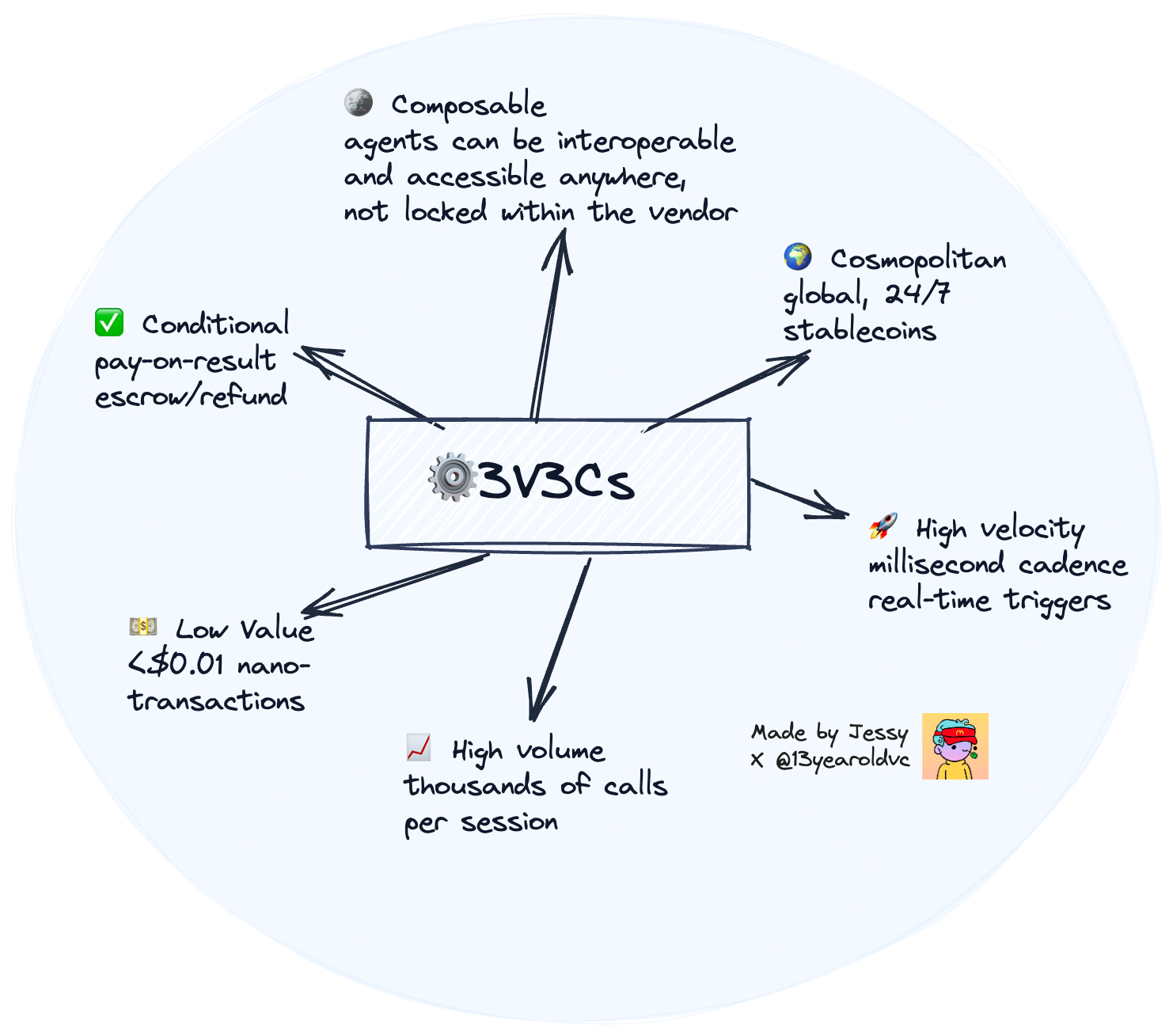
What do we mean by that?
We see three emergent behaviors
Humans paying agents (2C, 2B, complex optimizations)
Agents paying other agents (or humans)
Agents paying the web
Each of these all break the assumptions of traditional payment rails.
Human -> Agent
The chat interface is quietly becoming the new consumer gateway. Transactions that used to start in a browser are now happening in-line, inside conversations.
You can already buy Etsy and soon Shopify products directly through ChatGPT using its new Instant Checkout feature powered by Stripe. Google, Amazon, and Perplexity are testing similar shopping modes where AI assistants help you find and purchase items directly in the chat window.
These AI frontends are turning into digital storefronts via retail ecommerce (2C) - where discovery, comparison, and purchase all happen in one flow. Over time, people will rely on their AI agents as personal shoppers, travel planners, and booking assistants.
What’s interesting is how these agents behave differently from us:
They can monitor prices and auto-purchase when deals hit
Coordinate multi-party transactions (like booking flights and hotels together)
Or pay per-use for data or services that were previously locked behind subscriptions (we’ll discuss more on this via agent -> web later)
In the short term, most of these payments will probably still flow through legacy rails like Stripe or Visa - and that’s fine. For retail e-commerce (“2C”), the infrastructure is mature enough to handle the human-to-agent interface, at least for now.
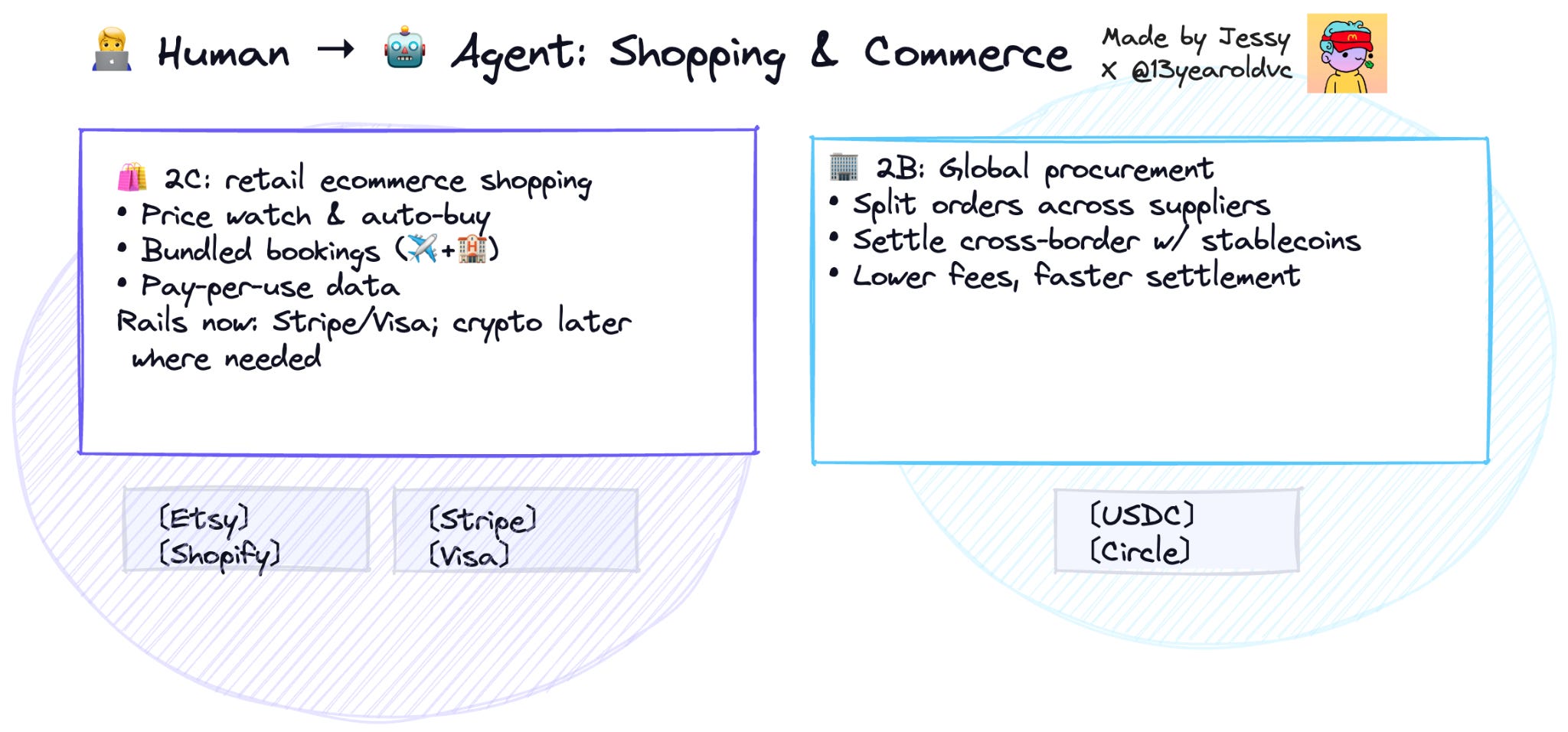
Where crypto starts to matter is on the global procurement side (2B).
Merchants and manufacturers overseas still struggle with settlement delays and high costs due to limited access to SWIFT or correspondent banking systems. Most small vendors in Yiwu, China (the world’s largest wholesale market for small commodities) still haven’t heard of stablecoins, but once regulation matures, this becomes a natural use case.
Stablecoins can move cross-border value instantly, cheaply, and transparently - just like how crypto remittances are already outcompeting Western Union.
In both consumer and enterprise cases, we’ll see new user behavior that simply wasn’t possible before: complex, conditional, 3V3C type purchases handled entirely by agents in the background, especially given when LLMs become even smarter and the cost significantly drops in the future, where the money saved from these interactions > costs of tokens:
A procurement agent that monitors multiple suppliers across continents, automatically splits orders between the cheapest manufacturers, and negotiates freight in the background while staying under a preset budget
A creative agent might bundle subscriptions across different SaaS tools and renew or cancel them dynamically based on usage
This is where you also need composability for agents to be modular: one agent’s output can become another’s input, forming complex multi-step workflows (agent swarms or chains of thought across models). Money legos now need to be agent legos too. In practical terms, composability requires standardized APIs, message schemas, and permissioning. Without those, agents exist in isolated silos, much like apps without APIs.
Hence, these are transactions that are too conditional, too high-frequency, need composability and too interdependent for humans or legacy rails to coordinate - but trivial for agents running on programmable payment systems.
Agent -> Agent
In the future, agents will need to hire other agents - and other humans - to get things done.
The current business models (subscriptions, licenses, paywalls) don’t fit how autonomous software interacts. Agents need to pay each other per call, per token, per inference, often priced below one cent or a few cents.
Imagine a research agent buying 100 API calls from a data agent, or a design agent paying a compute node for GPU minutes. They are machine-to-machine transactions, happening at high frequency and tiny value.
An agent needs to pay another agent $0.003 for 100 API calls. Or $0.15 for GPU minutes. Or $0.0001 per token inference.
Traditional payment rails can’t handle this. Credit cards charge a fee (eg 2.9% + 30 cents). At this scale, it’s unworkable.
Although from the UX standpoint, it may not be settled as high frequency and tiny value. For example, platforms like OpenRouter, where companies send millions of API calls a month, is settling these calls in credits via stablecoins, which is currently better UX than transacting every time.
Another even futuristic use case is if every robot had an agent attached to it - handling tasks, data, and operations (maybe with prepaid credits again). A drone might pay for weather data, navigation updates, or temporary access to a private delivery route.
That’s why a new programmable payment structure becomes interesting. Agents should be able to: define budgets and rules, pay beforehand, and settle instantly with proof of work completed.
In other words, crypto enables atomic payments between autonomous entities.
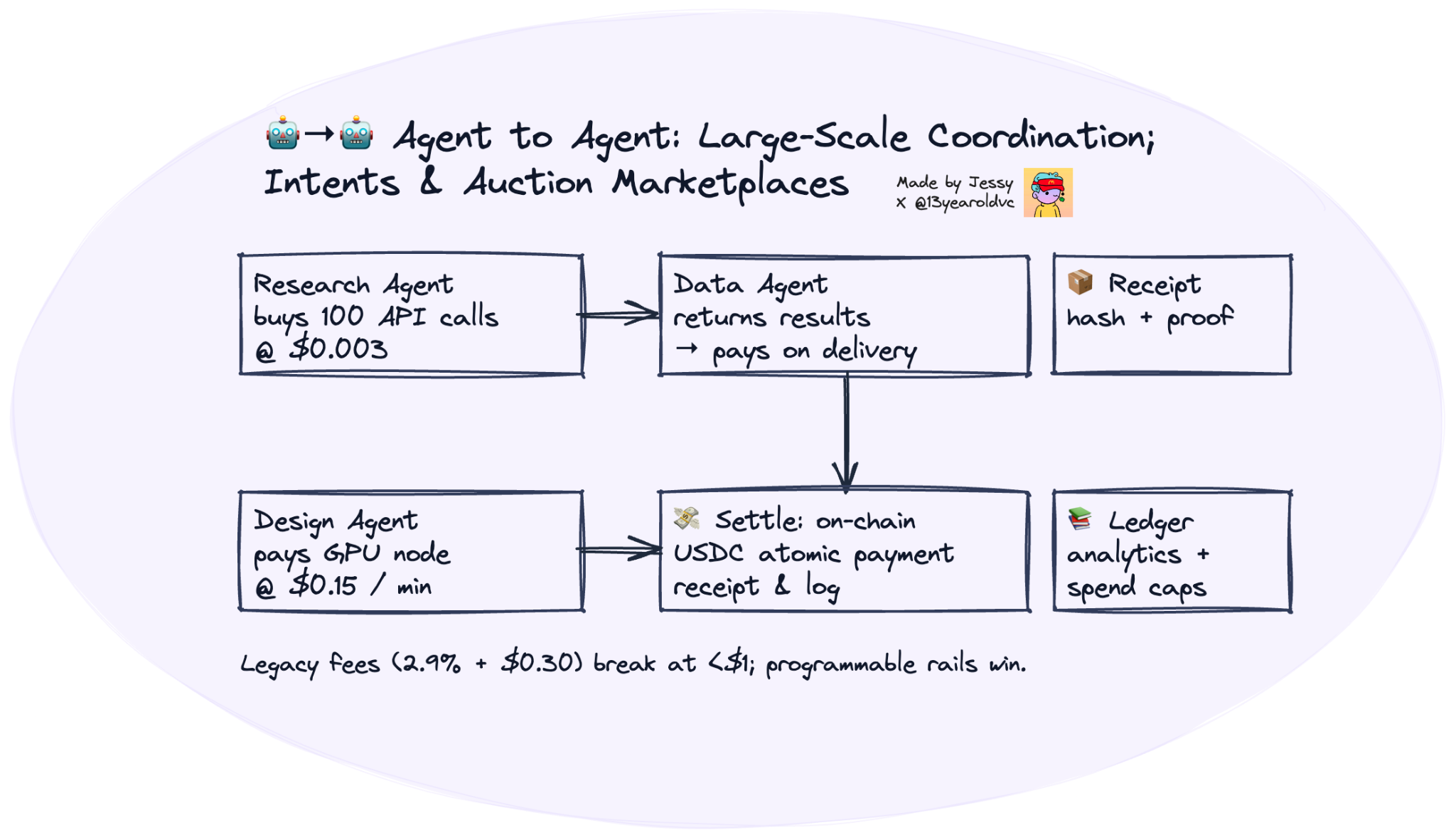
Over time, this extends beyond AI services. Agents may hire global human contributors directly, especially in international markets where stablecoins are already practical for payouts. The timing isn’t far off - we’re already seeing experiments from our conversations with builders, and large-scale adoption could happen within the next 1-2 years.
The pattern rhymes with remittances. For example, using an agent-friendly Fiverr style marketplace:
A marketing agent could commission dozens of micro-influencers across Southeast Asia, paying them automatically once engagement metrics clear a threshold.
A data-labeling agent might recruit annotators from Kenya or Bangladesh, stream micro-payments per task instead of waiting for batch invoices.
Once agents can move money instantly and globally, labor itself starts to look like an API call.
From a market design structure (that crypto uniquely has an edge in), once you have hundreds of thousands of autonomous entities consisting of humans + agents alike in the world, another trend can emerge as intent and auction marketplaces, as agents compete to fill requests.
The best-performing agent wins rewards (like stablecoins, reputation score, or on-chain credit line). Poor performers lose stake or reputation. This is exactly the vision we anticipate and want to build for at ERC-8004.
A strawman version of this could be:
Intent layer: a shared agent registry like ERC-8004 for posting structured requests with verified agents
Auction layer: having Dutch or English auctions for example, for fulfillment
Eval layer: crowd, other AI agents, or oracle verifies correctness; reward auto distributed
Settlement layer: payment in stablecoins; reputation and staking updated on-chain on ERC-8004 again
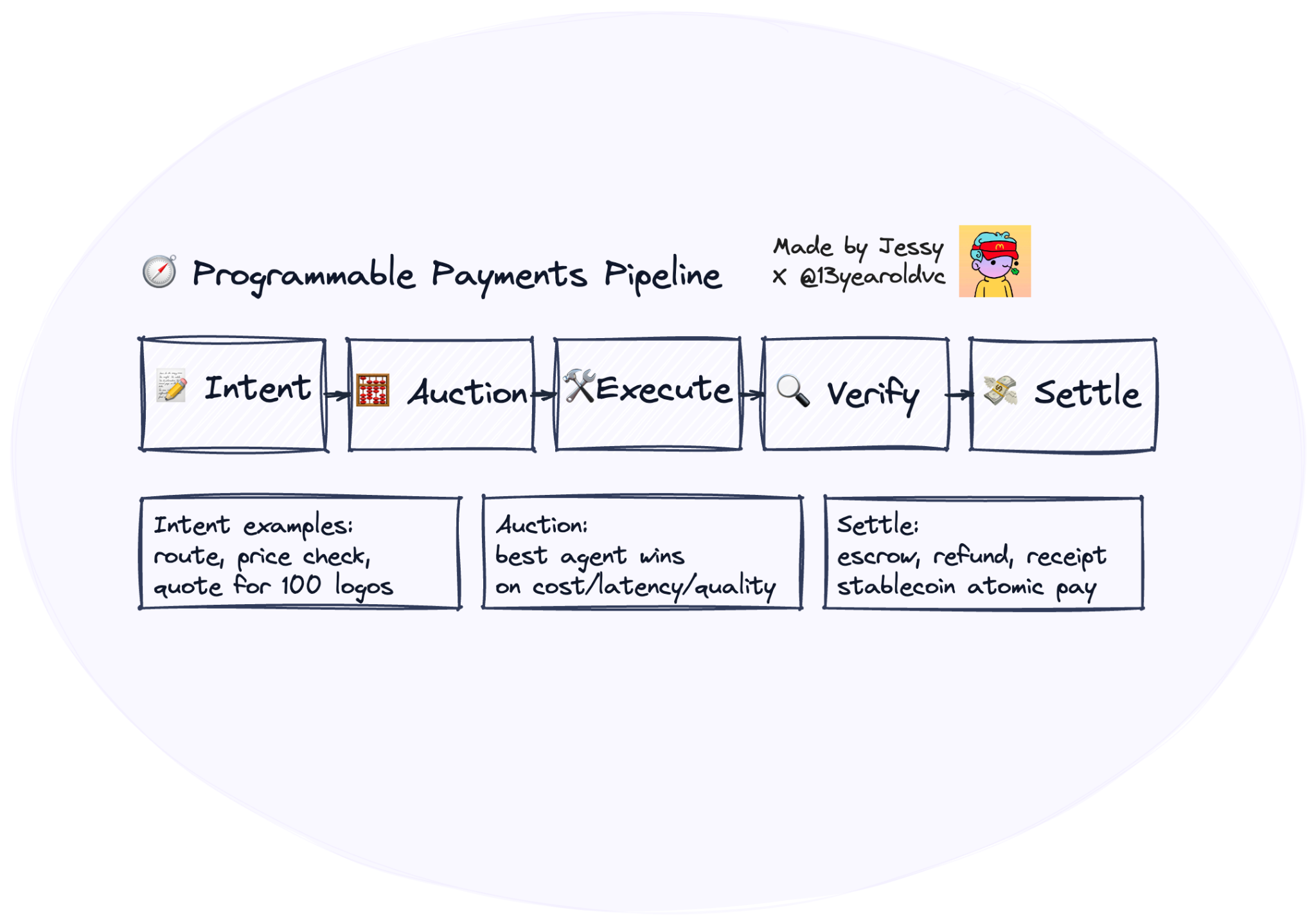
Another point on this is that decentralization previously was inefficient - parts of it was because humans are slow and coordination is costly. But now agents remove this bottleneck as they continuously evaluate who is best suited to act, what price is fair, and what data is trustworthy. Blockchains act as state coordination substrate - immutable, shared memory for results, stakes, and credits, while stablecoins are micro-payment rails for real-time value exchange (pay-per-answer, pay-per-action).
The very complexity of this agent <-> human coordination is exactly what blockchains and stablecoins were built for. Interoperability allows agents to communicate; composability allows them to cooperate.
Agent -> Web
The other trend to highlight is that the web is no longer just consumed by humans - it’s increasingly being crawled, read, and interacted with by AI agents, and will increasingly be dominated by agents in the future. That means the web will need to start charging machines, not people, we call it pay-per-crawl.
For example, publishers are fighting back against unrestricted scraping. Anthropic just paid $1.5 billion to settle a copyright lawsuit with authors - one of several cases testing whether AI companies can freely use copyrighted content. OpenAI, Microsoft, Meta, and others are all in similar disputes. The natural outcome is a pay-per-access model for training data and content usage.
At the same time, Cloudflare, which says ~20% of web-requests run through its network, is already experimenting with models where websites can charge agents nano-payments (not even micro) to access their data. They recently also launched NET Dollar, their stablecoin.
That’s where crypto rails make sense again.
Websites and APIs could expose a “payment required” endpoint - where an agent can pay a few cents or fractions thereof to read, query, or consume content, without subscriptions or ads. This turns the web into a network of microservices, where value flows continuously instead of in monthly billing cycles. If you’re interested in doing a deep dive into Andressen and others describing early internet days and 402 code, Jay Yu from Pantera Capital wrote a great piece on this.

In reality, the economics of “pay-per-crawl” will follow a power law. Only a handful of high-traffic or high-value sites - those sitting on data that agents truly need - will bother to integrate such monetization logic themselves. For the rest of the web, the effort to meter, charge, and account for agent traffic will outweigh the benefits. In other words, we think only a few major publishers will earn most of the revenue, while the long tail of websites will remain open-access or unmonetized.
That’s where intermediaries like Cloudflare could flip the curve. If Cloudflare lets sites “turn on agent payments” with a single switch - handling authentication, metering, and settlement through protocols like x402 or Web Bot Auth - the barrier to entry vanishes. Cloudflare could simply detect authorized agent requests, charge nano-payments on behalf of the site, and distribute revenue automatically. In this model, the open web itself gains a native machine-commerce layer: any page can become a metered API, and any agent can pay seamlessly as it browses, crawls, or learns.
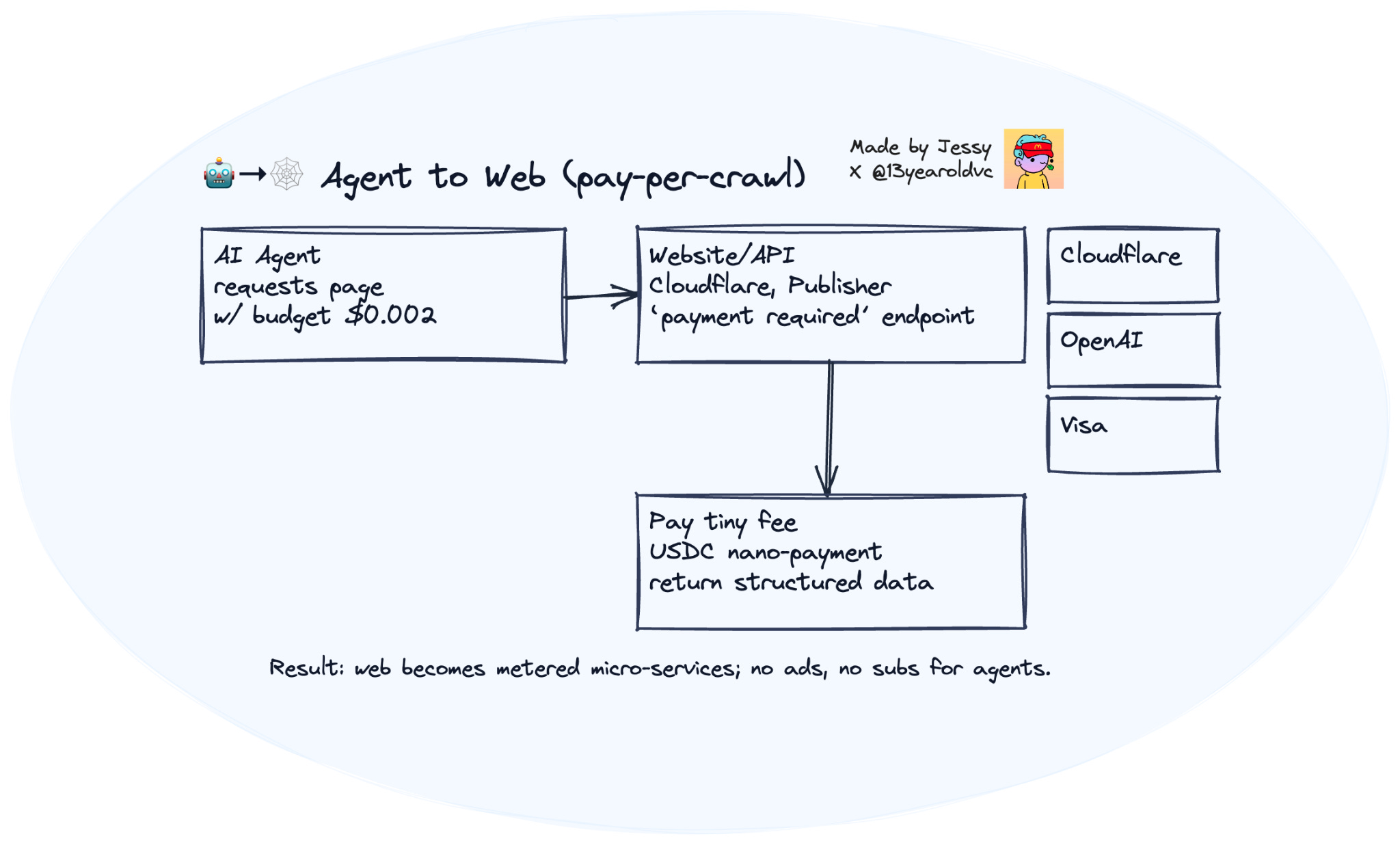
And it extends beyond data: every online business that can be consumed on a pay-per-use basis may eventually will. A conversation exchange with Louis Amira the cofounder of ATXP brought up some promising ways for enterprises to have new revenue channels examples:
LegalZoom could charge $2 for an NDA.
Netflix could charge 50¢ per episode if the payment experience were frictionless.
Replit could let you vibe-code forever at $1.23 per million tokens.
Further…
PitchBook or Bloomberg lets your agent pull a one-time valuation model for 25 cents
A hospital let you pay per record on anonymized oncology scan data for you to do cancer model training
Louis would start taking screenshots of all the places where he’d hit an unnecessary paywall/forced upgrade path. Every one of those companies could have marked up the price for pay per use basis and had him as a customer.
In an ideal world: developers from companies could spin up temporary API access for fractions of a dollar instead of monthly tiers, and writers or researchers could sell access to individual paragraphs, charts, or datasets on a per-query basis.
In turn, agents could have paid access to non-public data APIs, querying vendor data the web can’t scrape, per request, with prepaid micro-asks, which is a good fit for long tail APIs and enterprise datasets.
An early version of this is made by the Coinbase CDP team on Payments MCP, allowing LLMs to use onchain tools like wallets and payments with no API key required.
The internet starts to look less like a bundle of subscriptions and more like a living meter - value flowing continuously, with every interaction priced, paid, and settled in real time.
We are early, but the consolidation is coming
After doing a full round of research, the takeaway is that while the imagination space for agent payments is enormous, it’s also too early.
One of the biggest challenges is payments are one of the most regulated and permissioned domains on the internet, and adoption often depends less on technical feasibility than on integrations and interoperability with large enterprises and financial networks. That makes progress inherently slow. For startups, this means even if the primitives exist, it’s nearly impossible to experiment meaningfully without access to banks, card networks, or major payment processors.
Chances are, there will be enterprise grade, regulatory level things to worry about. Hence players like Catena Labs building their Agent Commerce Kit for agent identity, verification, and payments between agents/humans/businesses, with a focus on licensed financial institutions, regulatory readiness, and enterprise compliance. Paypal will probably attempt something similar.
Another challenge is currently most agents are really only half-autonomous now. Technically, most “agents” in production today are sophisticated workflow automations, not autonomous shoppers or negotiators. As Kevin Li (Goldsky) put it, “you can’t really sell full autonomous commerce right now - most AI companies are still doing workflow automation.” The near-term opportunity is the half-autonomous middle: human-initiated actions that trigger API-level, pay-per-use settlements over stablecoin rails. These flows aren’t fully agentic, but they exercise the same infrastructure - low-latency programmable wallets, per-call metering, and instant settlement = that will underpin true agent-to-agent commerce when the autonomy arrives.
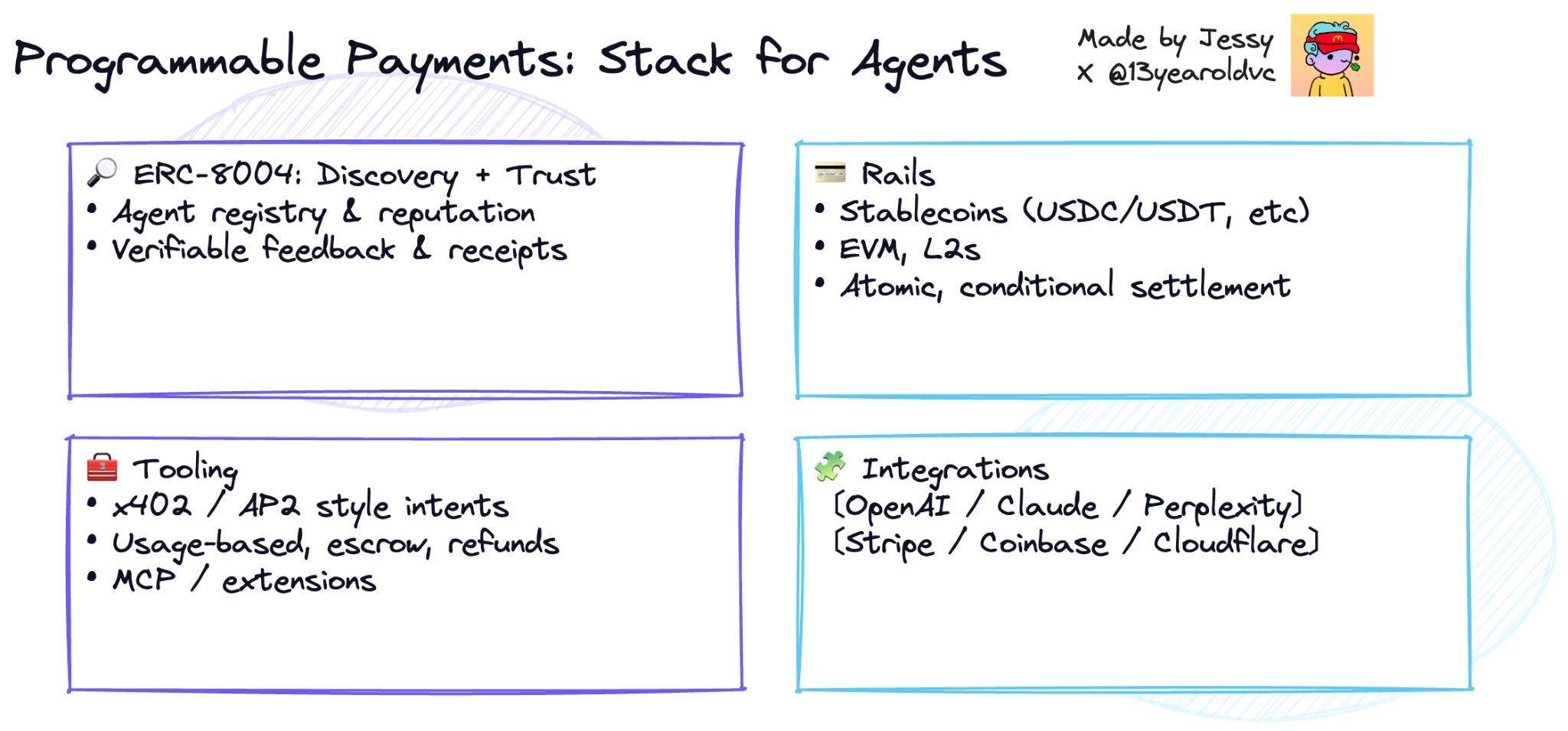
At the same time, the underlying blockchains also need to evolve - agentic payments demand stablecoin rails that support high-throughput, low-latency, privacy-preserving transactions. The next generation of payment L1s being explored by major players - like Stripe’s new L1 Tempo, Circle’s new native chain, and we are hopeful that more stablecoin focused teams in the Ethereum L2 space can also emerge (e.g., Codex). All of the above show that the infrastructure for programmable money is being rebuilt from the ground up to handle millions of micro and nano transactions per second.
Furthermore, programmable wallets and server-side architecture must evolve too. None of this works if wallets still assume a human guarding a seed phrase. Agentic commerce needs policy-driven, server-side custody - with programmable budgets, rate limits, spend scopes, multi-sig/TEE controls, and auditable approvals. That’s why programmable wallets matter: they provide key-management and policy primitives that agents can invoke without ever “holding a seed.” As Jamie Hinz (Privy) noted, four years ago we would’ve tried to bend Fireblocks or MetaMask into this shape; today the stack is being purpose-built so agents can transact under policy, not password - aligning security with automation rather than resisting it. (For a good overview, see Privy’s write-up on natural-language control and policy-based execution.)
But the shape of what’s coming is visible. Even Visa and Mastercard are now adapting their networks for agentic commerce, introducing protocols like Trusted Agent and Agent Pay built on Web Bot Auth - proof that identity, authentication, and settlement are rapidly converging across both blockchain and traditional rails.
We are probably just 1-2 breakthroughs away from this vision to exist.
The moment payments become programmable, the internet itself starts behaving differently. Every action can have clear value. Every workflow can settle. Every agent, whether a model or a human, can get paid for contribution in real time.
As infrastructure catches up, two standards are emerging that may power this shift: ERC-8004 offers a trust layer so agents can find and depend on each other without centralised intermediaries; x402 makes it possible for those agents to pay one another instantly and friction-free. Together they form the plumbing of an agentic economy.
We believe in a future where Agent A finds Agent B via ERC-8004 registry, negotiates service, then uses an agentic payment protocol (like x402) to pay instantly for that completed task, settled on Ethereum, the neutral financial layer.
For agents to meaningfully collaborate, they must be interoperable - able to discover, communicate, and exchange data through shared protocols - and composable, so their capabilities can build on one another.
Lincoln Murr (Coinbase): “Machine-to-machine payments being dominated by stablecoin rails could lead to stablecoin acceptance propagating widely. While Visa & Mastercard have a clear hold on human-oriented payment, agents are the trojan horse to bring crypto acceptance to the whole internet.”
It took 20 years for the web to go from pages to apps, and another 15 for apps to become platforms. Agents will compress that cycle. Commerce will stop being a thing you “do” and start being something that just happens - quietly, continuously, everywhere.
Disclaimer: The analyses and opinions expressed in this essay are solely those of the author and do not necessarily reflect the views of any organization, institution, or affiliated entity. The content is intended for informational and academic discussion purposes only and should not be interpreted as financial, investment, or legal advice. Readers are encouraged to conduct their own research and due diligence.
Valuable deep-dive - the emphasis on conditional payments, micro-settlement, and programmable wallets resonates with the operational finance and liquidity challenges TCLM covers. If you're tracking how agentic infrastructure could influence B2B financial workflows, it's worth a look.
(It’s free)- https://tradecredit.substack.com/
Thanks for writing this, it clarifies a lot. 'Building the rails of the machine economy' realy resonated. Sounds like us policymakers need to buckle up too, eh?